Conjunction (Basic ㊦ 468)
[x] is used when that which is expressed in the main clause is not what is expected from the content of the dependent ([x]) clause.
Equivalent: Even if; although
| (i) {V/Adjective(い/な)} て | も | |
| 話しても | Even is someone talks | |
| 食べても | Even if someone eats | |
| 高くても | Even if it is expensive | |
| 静かでも | Even if it is quiet | |
| (ii) Noun | でも | |
| 先生でも | even if someone is a teacher |
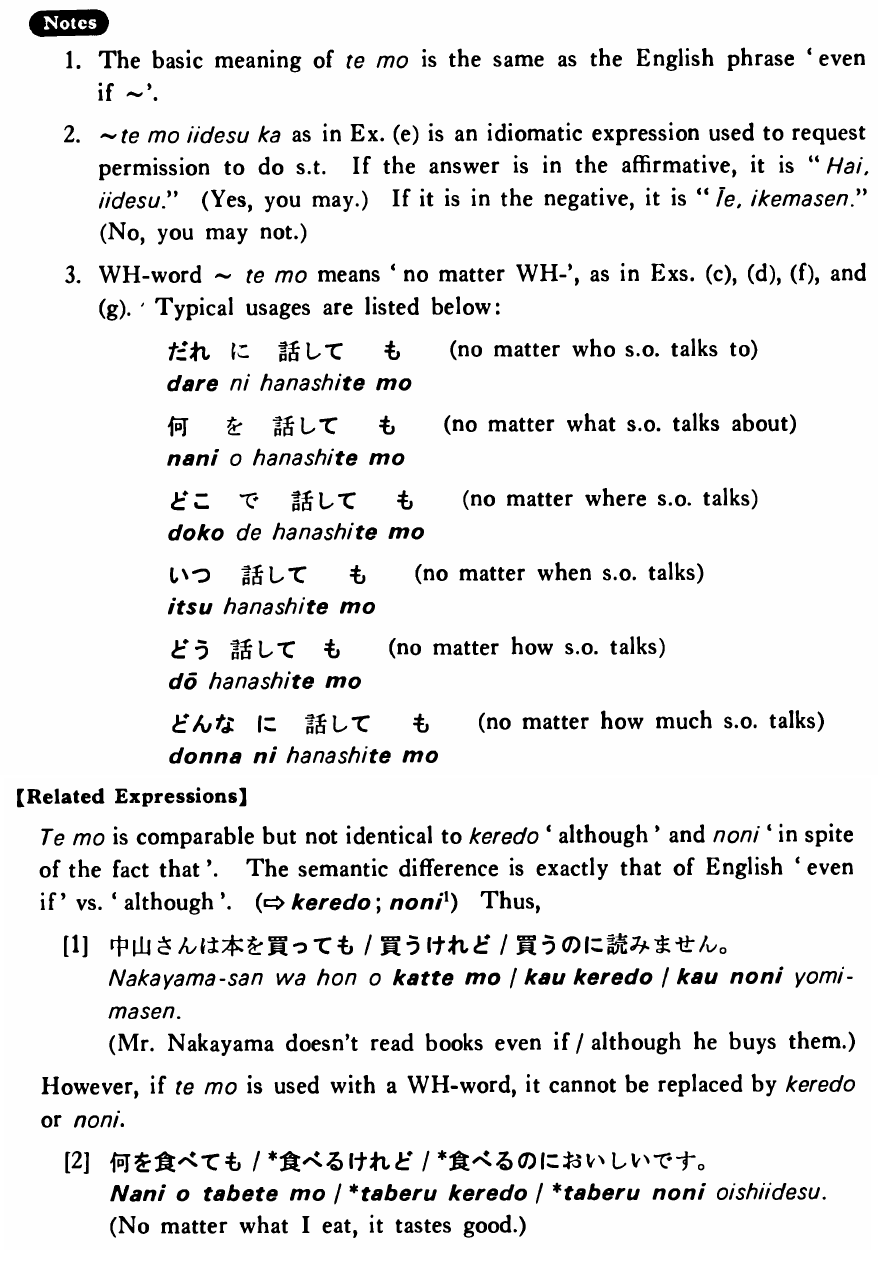
1. The basic meaning of ても is the same as the English phrase 'even if ~'
2. てもいいですか as in Example (e) is an idiomatic expression used to request permission to do something. If the answer is in the affirmative, it is "はい、いいです。" (Yes, you may.) If it is in the negative, it is "いえ、いけません。" (No, you may not.)
3. Interrogative word ても means 'no matter Interrogative word', as in Examples (c), (d), (f), and (g). Typical usages are listed below:
| 誰に話しても | no matter who someone talks to |
| 何を話しても | no matter what someone talks about |
| どこで話しても | no matter where someone talks |
| いつ話しても | no matter when someone talks |
| どう話しても | no matter how someone talks |
| どんなに話しても | no matter how much someone talks |
【Related Expressions】
ても is comparable but not identical to けれど 'although' and のに 'in spite of the fact that'. The semantic difference is exactly that of English 'even if' vs. 'although'. (⇨ けれど; のに1) Thus,
[1]
However, if て is used with an interrogative word, it cannot be replaced by けれど or のに.
[2]